Cesium Chinese Website: http://cesiumcn.org/ | China Fast Access: http://cesium.coinidea.com/
Nothing better demonstrates Cesium’s belief in combining geospatial and 3D computer graphics than the support of Epic Games and the Epic MegaGrants program to build Cesium for Unreal Engine.
This marks the first time a full-scale, high-precision 3D digital globe has been brought into a leading game engine, opening up a world of possibilities for Unreal users. Together, we will advance training and simulation, architecture, gaming, AR/VR, autonomous driving, and other industries by bringing 3D Tiles into the Unreal world to accurately visualize real-world locations captured by satellites and drones – using the same 3D geospatial knowledge that CesiumJS has employed for nearly a decade.
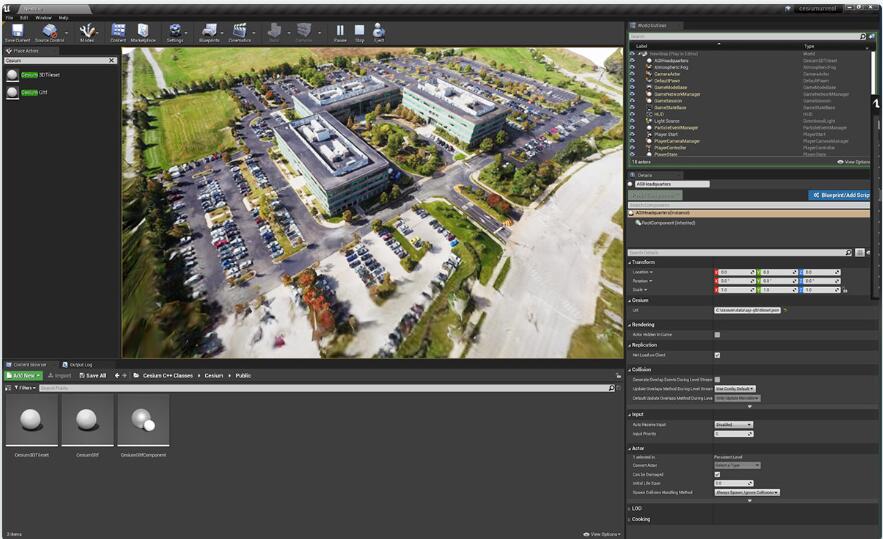
High-resolution photogrammetry 3D Tileset captured by drone at AGI headquarters, where Cesium was incubated.
“Our vision is to allow the simulation community to integrate Unreal Engine into their software architecture without having to change the way they work. Defining this 3D Tiles plugin with the Cesium team is a very exciting experience because it will allow the GeoInt community to streamline their pipelines. This activity is very much in line with our vision for big open worlds for all Unreal Engine users.” – Sebastien Loze, Simulation Industry Manager at Epic Games
When I started graphics programming in 1994, Epic, or Epic Megames as they were known then, was an inspiration. The graphics and gameplay of the DOS games they released were light years ahead of anything I had seen.
Today, Epic’s visual quality continues to inspire, especially with the announced Unreal Engine 5 approaching cinematic CG quality, with the Nanite virtualized micro-polygon pipeline and the Lumen dynamic global illumination engine. Combining Unreal’s strengths with Cesium’s advantages in global scale, precision, performance, and interoperability is a rare opportunity to advance 3D geospatial.
Our focus is on growing the 3D geospatial ecosystem using the 3D Tiles format: an OGC Community Standard for efficiently streaming massive heterogeneous real-world 3D datasets for visualization and analysis.
3D Tiles are widely used by government and commercial entities for global-scale terrain, city-wide photogrammetry, and massive point clouds from LiDAR. 3D Tiles support streaming of massive geometry and textures, as well as semantics computed by AI algorithms for runtime filtering, styling, and analysis. For example, point classification in point clouds can be used to filter foliage, or material properties on the sides of buildings in photogrammetry models can be used for communication networks, where RF propagation considers concrete or glass.
Cesium for Unreal will be open source and free on the Unreal Marketplace.

Cesium for Unreal will connect to the Cesium ion SaaS platform by default, providing ready-to-use 3D Tiles for terrain and 3D buildings, as well as first-class content pipelines for generating efficient 3D Tiles from source data such as terrain, imagery, and photogrammetry models. Cesium for Unreal will also be able to stream 3D Tiles with Cesium ion on internal private networks.
Stay tuned as we make progress. Feel free to reach out to discuss collaboration or share your Cesium for Unreal use cases.
Author: Patrick Cozzi Original link: https://cesium.com/blog/2020/06/04/cesium-for-unreal-engine/ Comment: Epic, Unreal Engine – gamers should all know about these. Cesium’s momentum is truly impressive.
Cesium Chinese Website QQ Group: 807482793
Cesium Chinese Website: http://cesiumcn.org/ | China Fast Access: http://cesium.coinidea.com/